

Demand for Bioplastics in South Korea Set for Rapid Growth, Projected to Reach USD 2,853.7 Million by 2036 | FMI Report
Demand for Bioplastics in South Korea
South Jeolla’s biopolymer sector is growing at 17.4% CAGR, driven by biodegradable mulching films tackling farm plastic waste with crop-specific innovation.
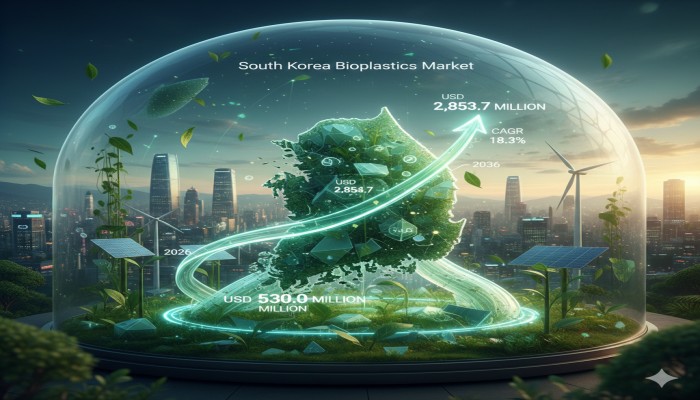
NEWARK, DE, UNITED STATES, January 20, 2026 /EINPresswire.com/ -- Demand for bioplastics in South Korea is entering a decade of accelerated expansion as the country restructures its petrochemical value chain to meet climate, regulatory, and consumer-driven sustainability targets. According to the latest industry outlook, the South Korean bioplastics market is projected to be valued at USD 530.0 million in 2026 and is forecast to reach USD 2,853.7 million by 2036, advancing at a compound annual growth rate (CAGR) of 18.3% during the forecast period.
Market Snapshot: Bioplastics in South Korea
• Market value (2026): USD 530.0 million
• Forecast value (2036): USD 2,853.7 million
• CAGR (2026–2036): 18.3%
• Leading material: PLA & PLA blends (38.5% share)
• Leading application: Packaging (45.5% share)
• High-growth regions: Jeju, South Gyeongsang, South Jeolla, North Jeolla
Unlock Growth Potential – Request Your Sample Now and Explore Market Opportunities!
https://www.futuremarketinsights.com/reports/sample/rep-gb-31562
Why Bioplastics Demand Is Accelerating
The primary driver of growth is South Korea’s K-Strategy on Carbon Neutrality, which explicitly promotes the replacement of fossil-based plastics with bio-based and biodegradable alternatives. Regulatory measures banning PVC in packaging, combined with incentives for biopolymer use in public procurement, are creating a stable baseline for long-term demand.
South Korea’s high-intensity food delivery and e-commerce culture generates a significant volume of single-use packaging waste. In response, retailers, logistics platforms, and brand owners are transitioning toward compostable and biodegradable packaging to meet regulatory requirements and align with evolving consumer expectations. At the same time, ESG integration across corporate supply chains is accelerating material substitution decisions at scale.
Industrial Retrofitting and Technology Adoption
South Korea’s advanced chemical engineering infrastructure is playing a critical role in enabling the transition. Existing petrochemical facilities are being retrofitted to process renewable feedstocks, allowing manufacturers to scale bioplastic production without building entirely new industrial ecosystems.
Technological adoption is increasingly focused on:
• Second-generation feedstocks that do not compete with food sources
• Advanced polymerization techniques that improve heat resistance and barrier performance
• Marine-degradable polymers designed to reduce coastal and microplastic pollution
Public research institutes are working closely with private manufacturers to develop high-performance bioplastics that match the functional properties of conventional plastics while meeting certified compostability standards.
Segment Insights: Materials and Applications
PLA and PLA Blends Lead Material Adoption
PLA & PLA blends account for 38.5% of the market, supported by commercial availability, cost advantages, and versatility. South Korean manufacturers widely use PLA in thermoformed food containers, coffee cups, and 3D printing filaments. Continuous improvements in impact strength and thermal stability are expanding PLA’s use beyond cold-chain applications.
Packaging Drives Volume Growth
Packaging represents 45.5% of total bioplastics demand. South Korea’s dense retail landscape and sophisticated e-commerce infrastructure generate sustained demand for flexible and rigid packaging solutions. Cosmetic, beverage, and personal care brands are increasingly using renewable bioplastic materials to maintain brand loyalty and comply with waste reduction mandates.
Agriculture and Bio-Polyesters
Biodegradable polyesters are gaining traction in agriculture, particularly for soil-biodegradable mulching films. These materials eliminate post-harvest plastic collection, reduce labor costs, and mitigate soil contamination, supported by government subsidies for eco-friendly farming inputs.
Bio-PET in Bottling
Bio-PET continues to play a strategic role in beverage packaging. Its compatibility with existing recycling infrastructure and processing equipment allows producers to increase bio-based content without disrupting operations, supporting corporate commitments to sustainable packaging by 2030.
Regional Growth Dynamics
Bioplastics adoption varies significantly by region, reflecting differences in industrial structure and environmental policy enforcement.
• Jeju (CAGR: 22.0%)
Driven by the “Carbon-Free Island 2030” policy, Jeju enforces strict bans on non-degradable single-use plastics. Tourism, hospitality, and food services are major demand drivers, positioning the island as a testing ground for circular economy models.
• South Gyeongsang (CAGR: 19.3%)
Home to major petrochemical hubs, this region is leading industrial retrofitting efforts. Demand is driven by automotive and shipbuilding industries seeking sustainable bio-composites and interior components.
• South Jeolla (CAGR: 17.4%)
Agricultural demand dominates, with widespread adoption of biodegradable mulching films supported by regional subsidies and crop-specific material innovation.
• North Jeolla (CAGR: 14.7%)
Growth is supported by bio-industry clusters and food processing hubs, where compostable packaging solutions are increasingly integrated into food safety and processing standards.
Competitive Landscape and Industry Structure
The competitive environment is defined by a mix of global material suppliers and expanding domestic players. NatureWorks LLC currently holds an estimated 35.0% market share, leveraging established PLA supply chains. However, South Korean conglomerates including CJ CheilJedang, SKC, LG Chem, Lotte Chemical, and Hanwha Solutions are investing aggressively in production capacity, joint ventures, and strain-engineering technologies.
Mergers and acquisitions are increasingly focused on biotechnology startups with proprietary fermentation and polymer synthesis capabilities. Vertical integration—from feedstock sourcing to polymer compounding—is emerging as a key strategy to improve cost competitiveness and supply chain resilience.
Outlook Through 2036
Despite strong momentum, the sector continues to face challenges related to production costs and price sensitivity, particularly for small and mid-sized manufacturers. Achieving scale efficiencies and process optimization will be critical to narrowing the cost gap with conventional plastics.
Overall, the South Korean bioplastics market is positioned for sustained, structurally driven growth through 2036, supported by policy alignment, industrial transformation, and rising environmental accountability across the value chain.
Why FMI: https://www.futuremarketinsights.com/why-fmi
Related Reports Insights from Future Market Insights (FMI)
Polysorbate 20 Market https://www.futuremarketinsights.com/reports/polysorbate-20-market
Demand for Microfiber Synthetic Leather in Japan https://www.futuremarketinsights.com/reports/japan-microfiber-synthetic-leather-market
Demand for Microfined Graphite Powder in Japan https://www.futuremarketinsights.com/reports/japan-microfined-graphite-powder-market
Rain-Erosion Resistant Offshore Blade Edge Coatings Market https://www.futuremarketinsights.com/reports/rain-erosion-resistant-offshore-blade-edge-coatings-market
About Future Market Insights (FMI)
Future Market Insights, Inc. (FMI) is an ESOMAR-certified, ISO 9001:2015 market research and consulting organization, trusted by Fortune 500 clients and global enterprises. With operations in the U.S., UK, India, and Dubai, FMI provides data-backed insights and strategic intelligence across 30+ industries and 1200 markets worldwide.
Sudip Saha
Future Market Insights Inc.
+1 347-918-3531
email us here
Legal Disclaimer:
EIN Presswire provides this news content "as is" without warranty of any kind. We do not accept any responsibility or liability for the accuracy, content, images, videos, licenses, completeness, legality, or reliability of the information contained in this article. If you have any complaints or copyright issues related to this article, kindly contact the author above.
